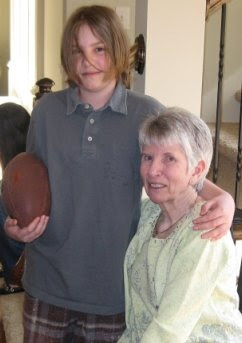
Friday, May 8, 2009

Ill. Volunteers Married at Homeless Shelter

Not sure why, but this story struck me this morning.

Associated Press
Mon Apr 27, 12:35 am ET

SPRINGFIELD, Ill. – Two central Illinois volunteers have tied the knot in the place they first met: a homeless shelter.

Joyce and Joe Reynolds were married Saturday at the Washington Street Mission in Springfield.

On the first day they met at the mission, Joyce Reynolds says she mistook her future husband for a homeless man seeking shelter.

But Joe Reynolds, who is a longtime volunteer and leads Bible studies at the shelter, says he set her straight.

The Reynolds went on their first date a month after that first meeting.

About 100 people, including the homeless who rely on the shelter, attended Saturday's wedding.

The Reynolds say they plan to continue volunteering.
___
Information from: The State Journal-Register, http://www.sj-r.com

Monday, May 4, 2009

Will Post for Food

Reconciling Homeschooling Realities and Entrepreneurial Endeavors with Semi-Random Creative Verve Melted on Top: All of This & More in Just One Blog!


This was one of the suggested names that came as a result of my Name Change Poll. I have to admit; it does ring true...don't you think? I've decided to add the "Will Post for Food" part to the blog title permanently but to otherwise leave the title as it is. Raves & Rants of a Homeschool Mom: Will Post for Food. Thanks for participating in the poll! Fun one.


So, the first post of a new month. I love the beginning of the month. The monthly bulletin board of images has to be updated, and this month, I am focusing solely on Memorial Day; though I do acknowledge all of the other cultural Holidays and celebrations this month.


Happy...

Polski Day!
Cinco de Mayo!
Armed Forces Day!
Grandma Yadrich's Birthday!
New Grandma's Birthday!
Mother's Day!
Old Grandma's (my Mother) Birthday!
Memorial Day!
Asian-Pacific American Month!
Physical Fitness Month!

...and whatever other honorable holidays I MAY have missed!


The beginning of the month is also a time of reflection of the month past and in looking ahead to all of the wonderful things we will experience in the days to come.


Last month, Doug shot his first turkey. He was so excited, and Cole and I are so proud. He also brought home a bunch of morels, which we were quick to wash up, fry up, and eat up! Our chef buddy and Doug cleaned up the bird, and the amazing-looking meat is in the fridge, waiting to be cooked this weekend.


We had a lovely time with our extended family for Grandma Beasley's birthday in April and then again for Easter - when we also met our new little cousin, Whitney. She is a little angel and surely gets it from her Daddy.


Cole wrapped up his second month of guitar lessons last month and is really enjoying spending time with our friend, Danny. He's not much into practicing his guitar yet, and though he gets nervous before each lesson due to his lack of practice, he is not so moved as to change his behavior at this point. I remember starting band at his age, and learning to read - let alone play- music was intimidating and completely alien at first. One of these days, the light bulb will turn on, and he'll "get it" and be on his rockin' way.


My marketing firm, Innovative Design & Marketing LLC, picked up two new clients in April. Each new client heard its own little whoop of joy from me as in this economy, simply maintaining clients is a challenge. I also picked up two coaching clients - one seeking career coaching, the other adult ADHD coaching.


All in all, April was a GREAT month!


This May is a particularly exciting month for our household as it marks the conclusion of our first year as homeschoolers!


After two and a half weeks in public school at the onset of the 2008-09 school year, we decided enough was enough and removed Cole from school. Our decision was based on a culmination of previous and consistent disappointments within a variety of institutionalized education systems - both public and private - and was one of the single best decisions we've ever made for Cole and for our family.


The emotional rush of anger with our local public school combined with the positive energy in a dream realized in being able to finally homeschool Cole propelled us head-on into our homeschooling experience. The decision was made within a 30 second exchange in the school office, and we never looked back, nor did Cole (or us) suffer any negative transition - primarily because we had been wishful for the opportunity to educate Cole in this way for the past four years (and Cole was stoked we'd rescued him).


Cole now is learning in an organic, natural, and passion-driven fashion. We don't have bedtimes or set alarm clocks to wake by (well, we do if I'm traveling), but we don't sit around and talk about iCarly all day....lol..well, okay - we some times we do. Mostly, we are a family think tank driven by and intertwined by our three individual interests (respectively) and by all of the other stuff going on around us - what we see, hear, taste, smell, feel, and think about on a daily basis. We are all very project driven, and if you walked into our dining room, the piles on the table in front of you are a hint at what we are currently immersed.


Another bonus in homeschooling - and a timely topic with the swine flu epidemic: Cole's last full year in school had him down with strep SIX times. This meant six rounds of antibiotics (at least), never-ending make-up work and feeling behind, negative attitudes from the staff who felt we exaggerated the extent of Cole's illnesses, and so on. Within the past twelve months, Cole has had strep ZERO times (knock on wood)...a truly amazing feat when you've dealt with the school year unwellness blues we have.


In summary, we love unschooling!


Soooo...back to it being the first of the month. Yet another reason I love the first of any month are the new magazine subscriptions that begin to arrive in my mail box. This is one of my few green-guilty pleasures, but I do oh-so love my magazines (I also do try to make sure to pick up half of my monthly mags from the local library's donation box.) The latest, greatest from Scientific America, National Geographic, Inc., Fast Company, Entrepreneur, Harper's, the New Yorker, the Humanist, and many, many more. Cole digs into Highlights, Hot Rod, and NatGeo. Some of my favorite evenings are spent sitting around discussing the articles we're all respectively getting into, interrupting each other to read a bit out loud here and there. Awesome!


Beginnings are always so exciting! : )


Here are a few projects we are working on this May.


Windowsill Herb Garden: Here are a couple of photos of Cole planting basil seeds.


We are attempting basil, mint, parsley, cilantro, and maybe a couple of others. All of our dreams involve moving to the Country, and in hopeful preparation, we thought we'd better brush up on growing things.
Cole has also been diligently tracking the many storms that have passed through, and we are discussing creating a weather center in Cole's den. For sure, the kiddo needs a Farmer's Almanac. They are expensive, so we'll have to start budgeting it in. Cole is obsessed with comparing the historical daily highs and lows to current temperature trends. We do a lot of research on global warming, droughts, flooding, etc. Bottom line, this kid is cuckoo for weather.
I found an old airplane kit while digging for dirty laundry in Cole's room the other day. Cole and Doug spent an afternoon working on different models, making adjustments based on their objectives - straight, fast flying plans, loop-de-loo planes, hover planes, etc. It was a wonderful afternoon of flight and physics.


Cole, Doug, and I are also working on a philanthropic project this month. A friend of mine from high school/college, Jackie (Smith) Malena, is battling hepatacelluar carcinoma - a rare cancer of the liver - and is in need of additional funds to continue her treatment. This is Jackie's 2nd occurrence of cancer in seven years, and as you can imagine, their family's savings have been exhausted.
We are volunteering at their May 22nd Fun Run fund-raising event in Liberty and are also utilizing Fun & Funky Finds (my company's web store) as a means to help raise funds for Jackie's cancer treatment fund. 100% of the proceeds from Jackie's page are being donated to the fund.
If you are looking for a gift for Mother's Day, Graduation, a wedding, birthday, or any other special occasion, please take a second to consider supporting cancer warrior, Jackie Malena at Fun & Funky Finds.

Cole and I are also working on Mother's Day-related art projects, which we simply cannot disclose at this time. : ) Photos to follow soon.
I'm behind in my blogging. Several blog posts are in draft-form, and I'm determined to get them finished and posted before the pool opens....or it'll never happen.
Don't forget to check The Cole Train - Cole's weekly blog quote, and as always, thanks for your comments and for your continued support in our unschooling endeavor!
xo, Diane

Wednesday, April 29, 2009

Spring in Missouri!

ahhhhhhh...Spring in Missouri means morels! Doug hunted down a bundle after foregoing turkey hunting yesterday. Morels + egg + flour + some salt & pepper + a hot pan full of oil = heaven!
(Doug did get a two-bearded jake today! woo hoo! It was his first turkey.)


Tuesday, April 28, 2009

Raves & Rants?

Well, there is a lot of that going on around here for sure!!

It's been suggested that perhaps this is not really a homeschool/unschool blog. What does that mean anyway? Does everything have to be so black and white - so categorized. Bleh!

However, in light of this comment, I thought I'd see if anyone thought a different name would be in order.

Take a second to vote on Name This Blog on the top right hand column.

New York City-sized ice collapses off Antarctica

By Alister Doyle, Environment Correspondent

TROMSOE, Norway (Reuters) - An area of an Antarctic ice shelf almost the size of New York City has broken into icebergs this month after the collapse of an ice bridge widely blamed on global warming, a scientist said Tuesday.

"The northern ice front of the Wilkins Ice Shelf has become unstable and the first icebergs have been released," Angelika Humbert, glaciologist at the University of Muenster in Germany, said of European Space Agency satellite images of the shelf.


Humbert told Reuters about 700 sq km (270.3 sq mile) of ice -- bigger than Singapore or Bahrain and almost the size of New York City -- has broken off the Wilkins this month and shattered into a mass of icebergs.

She said 370 sq kms of ice had cracked up in recent days from the Shelf, the latest of about 10 shelves on the Antarctic Peninsula to retreat in a trend linked by the U.N. Climate Panel to global warming.

The new icebergs added to 330 sq kms of ice that broke up earlier this month with the shattering of an ice bridge apparently pinning the Wilkins in place between Charcot island and the Antarctic Peninsula.

Nine other shelves -- ice floating on the sea and linked to the coast -- have receded or collapsed around the Antarctic peninsula in the past 50 years, often abruptly like the Larsen A in 1995 or the Larsen B in 2002.

The trend is widely blamed on climate change caused by heat-trapping gases from burning fossil fuels, according to David Vaughan, a British Antarctic Survey scientist who landed by plane on the Wilkins ice bridge with two Reuters reporters in January.

Humbert said by telephone her estimates were that the Wilkins could lose a total of 800 to 3,000 sq kms of area after the ice bridge shattered.

The Wilkins shelf has already shrunk by about a third from its original 16,000 sq kms when first spotted decades ago, its ice so thick would take at least hundreds of years to form.

Temperatures on the Antarctic Peninsula have warmed by up to 3 Celsius (5.4 Fahrenheit) this century, Vaughan said, a trend climate scientists blame on global warming from burning fossil fuels in cars, factories and power plants.

The loss of ice shelves does not raise sea levels significantly because the ice is floating and already mostly submerged by the ocean.

But the big worry is that their loss will allow ice sheets on land to move faster, adding extra water to the seas.

Wilkins has almost no pent-up glaciers behind it, but ice shelves further south hold back vast volumes of ice.

The Arctic Council, grouping nations with territory in the Arctic, is due to meet in Tromsoe, north Norway, Wednesday to debate the impact of melting ice in the north.

(Source: Scientific American. www.sciam.com Editing by Sophie Hares)


Additional Info on and Images of Wilkins:

From the NSIDC (National Snow and Ice Data Center):

From NASA:

From the European Space Agency:

Monday, April 27, 2009

What Do Piracy, Swine Flu, and Going Green Have in Common?

A recent article in Scientific American ties these topics together in a chilling story of global food shortages.

Read more below...

Could Food Shortages Bring Down Civilization?
The biggest threat to global stability is the potential for food crises in poor countries to cause government collapse.

By Lester R. Brown

One of the toughest things for people to do is to anticipate sudden change. Typically we project the future by extrapolating from trends in the past. Much of the time this approach works well. But sometimes it fails spectacularly, and people are simply blindsided by events such as today’s economic crisis.

For most of us, the idea that civilization itself could disintegrate probably seems preposterous. Who would not find it hard to think seriously about such a complete departure from what we expect of ordinary life? What evidence could make us heed a warning so dire—and how would we go about responding to it? We are so inured to a long list of highly unlikely catastrophes that we are virtually programmed to dismiss them all with a wave of the hand: Sure, our civilization might devolve into chaos—and Earth might collide with an asteroid, too!

For many years I have studied global agricultural, population, environmental and economic trends and their interactions. The combined effects of those trends and the political tensions they generate point to the breakdown of governments and societies. Yet I, too, have resisted the idea that food shortages could bring down not only individual governments but also our global civilization.

I can no longer ignore that risk. Our continuing failure to deal with the environmental declines that are undermining the world food economy—most important, falling water tables, eroding soils and rising temperatures—forces me to conclude that such a collapse is possible.

The Problem of Failed StatesEven a cursory look at the vital signs of our current world order lends unwelcome support to my conclusion. And those of us in the environmental field are well into our third de­­cade of charting trends of environmental decline without seeing any significant effort to reverse a single one.

In six of the past nine years world grain production has fallen short of consumption, forcing a steady drawdown in stocks. When the 2008 harvest began, world carryover stocks of grain (the amount in the bin when the new harvest begins) were at 62 days of consumption, a near record low. In response, world grain prices in the spring and summer of last year climbed to the highest level ever.

As demand for food rises faster than supplies are growing, the resulting food-price inflation puts severe stress on the governments of countries already teetering on the edge of chaos. Unable to buy grain or grow their own, hungry people take to the streets. Indeed, even before the steep climb in grain prices in 2008, the number of failing states was expanding [Purchase the digital edition to see related sidebar]. Many of their problems stem from a failure to slow the growth of their populations. But if the food situation continues to deteriorate, entire nations will break down at an ever increasing rate. We have entered a new era in geopolitics. In the 20th century the main threat to international security was superpower conflict; today it is failing states. It is not the concentration of power but its absence that puts us at risk.

States fail when national governments can no longer provide personal security, food security and basic social services such as education and health care. They often lose control of part or all of their territory. When governments lose their monopoly on power, law and order begin to disintegrate. After a point, countries can become so dangerous that food relief workers are no longer safe and their programs are halted; in Somalia and Afghanistan, deteriorating conditions have already put such programs in jeopardy.

Failing states are of international concern because they are a source of terrorists, drugs, weapons and refugees, threatening political stability everywhere. Somalia, number one on the 2008 list of failing states, has become a base for piracy. Iraq, number five, is a hotbed for terrorist training. Afghanistan, number seven, is the world’s leading supplier of heroin. Following the massive genocide of 1994 in Rwanda, refugees from that troubled state, thousands of armed soldiers among them, helped to destabilize neighboring Democratic Republic of the Congo (number six).

Our global civilization depends on a functioning network of politically healthy nation-states to control the spread of infectious disease, to manage the international monetary system, to control international terrorism and to reach scores of other common goals. If the system for controlling infectious diseases—such as polio, SARS or avian flu—breaks down, humanity will be in trouble. Once states fail, no one assumes responsibility for their debt to outside lenders. If enough states disintegrate, their fall will threaten the stability of global civilization itself.

A New Kind of Food ShortageThe surge in world grain prices in 2007 and 2008—and the threat they pose to food security—has a different, more troubling quality than the increases of the past. During the second half of the 20th century, grain prices rose dramatically several times. In 1972, for instance, the Soviets, recognizing their poor harvest early, quietly cornered the world wheat market. As a result, wheat prices elsewhere more than doubled, pulling rice and corn prices up with them. But this and other price shocks were event-driven—drought in the Soviet Union, a monsoon failure in India, crop-shrinking heat in the U.S. Corn Belt. And the rises were short-lived: prices typically returned to normal with the next harvest.

In contrast, the recent surge in world grain prices is trend-driven, making it unlikely to reverse without a reversal in the trends themselves. On the demand side, those trends include the ongoing addition of more than 70 million people a year; a growing number of people wanting to move up the food chain to consume highly grain-intensive livestock products [see “The Greenhouse Hamburger,” by Nathan Fiala; Scientific American, February 2009]; and the massive diversion of U.S. grain to ethanol-fuel distilleries.

The extra demand for grain associated with rising affluence varies widely among countries. People in low-income countries where grain supplies 60 percent of calories, such as India, directly consume a bit more than a pound of grain a day. In affluent countries such as the U.S. and Canada, grain consumption per person is nearly four times that much, though perhaps 90 percent of it is consumed indirectly as meat, milk and eggs from grain-fed animals.

The potential for further grain consumption as incomes rise among low-income consumers is huge. But that potential pales beside the insatiable demand for crop-based automotive fuels. A fourth of this year’s U.S. grain harvest—enough to feed 125 million Americans or half a billion Indians at current consumption levels—will go to fuel cars. Yet even if the entire U.S. grain harvest were diverted into making ethanol, it would meet at most 18 percent of U.S. automotive fuel needs. The grain required to fill a 25-gallon SUV tank with ethanol could feed one person for a year.

The recent merging of the food and energy economies implies that if the food value of grain is less than its fuel value, the market will move the grain into the energy economy. That double demand is leading to an epic competition between cars and people for the grain supply and to a political and moral issue of unprecedented dimensions. The U.S., in a misguided effort to reduce its dependence on foreign oil by substituting grain-based fuels, is generating global food insecurity on a scale not seen before.

Water Shortages Mean Food ShortagesWhat about supply? The three environmental trends I mentioned earlier—the shortage of freshwater, the loss of topsoil and the rising temperatures (and other effects) of global warming—are making it increasingly hard to expand the world’s grain supply fast enough to keep up with demand. Of all those trends, however, the spread of water shortages poses the most immediate threat. The biggest challenge here is irrigation, which consumes 70 percent of the world’s freshwater. Millions of irrigation wells in many countries are now pumping water out of underground sources faster than rainfall can recharge them. The result is falling water tables in countries populated by half the world’s people, including the three big grain producers—China, India and the U.S.

Usually aquifers are replenishable, but some of the most important ones are not: the “fossil” aquifers, so called because they store ancient water and are not recharged by precipitation. For these—including the vast Ogallala Aquifer that underlies the U.S. Great Plains, the Saudi aquifer and the deep aquifer under the North China Plain—depletion would spell the end of pumping. In arid regions such a loss could also bring an end to agriculture altogether.

In China the water table under the North China Plain, an area that produces more than half of the country’s wheat and a third of its corn, is falling fast. Overpumping has used up most of the water in a shallow aquifer there, forcing well drillers to turn to the region’s deep aquifer, which is not replenishable. A report by the World Bank foresees “catastrophic consequences for future generations” unless water use and supply can quickly be brought back into balance.

As water tables have fallen and irrigation wells have gone dry, China’s wheat crop, the world’s largest, has declined by 8 percent since it peaked at 123 million tons in 1997. In that same period China’s rice production dropped 4 percent. The world’s most populous nation may soon be importing massive quantities of grain.

But water shortages are even more worrying in India. There the margin between food consumption and survival is more precarious. Millions of irrigation wells have dropped water tables in almost every state. As Fred Pearce reported in New Scientist:
Half of India’s traditional hand-dug wells and millions of shallower tube wells have already dried up, bringing a spate of suicides among those who rely on them. Electricity blackouts are reaching epidemic proportions in states where half of the electricity is used to pump water from depths of up to a kilometer [3,300 feet].

A World Bank study reports that 15 percent of India’s food supply is produced by mining groundwater. Stated otherwise, 175 million Indians consume grain produced with water from irrigation wells that will soon be exhausted. The continued shrinking of water supplies could lead to unmanageable food shortages and social conflict.

Less Soil, More HungerThe scope of the second worrisome trend—the loss of topsoil—is also startling. Topsoil is eroding faster than new soil forms on perhaps a third of the world’s cropland. This thin layer of essential plant nutrients, the very foundation of civilization, took long stretches of geologic time to build up, yet it is typically only about six inches deep. Its loss from wind and water erosion doomed earlier civilizations.

In 2002 a U.N. team assessed the food situation in Lesotho, the small, landlocked home of two million people embedded within South Africa. The team’s finding was straightforward: “Agriculture in Lesotho faces a catastrophic future; crop production is declining and could cease altogether over large tracts of the country if steps are not taken to reverse soil erosion, degradation and the decline in soil fertility.”

In the Western Hemisphere, Haiti—one of the first states to be recognized as failing—was largely self-sufficient in grain 40 years ago. In the years since, though, it has lost nearly all its forests and much of its topsoil, forcing the country to import more than half of its grain.

The third and perhaps most pervasive environmental threat to food security—rising surface temperature—can affect crop yields everywhere. In many countries crops are grown at or near their thermal optimum, so even a minor temperature rise during the growing season can shrink the harvest. A study published by the U.S. National Academy of Sciences has confirmed a rule of thumb among crop ecologists: for every rise of one degree Celsius (1.8 degrees Fahrenheit) above the norm, wheat, rice and corn yields fall by 10 percent.

In the past, most famously when the innovations in the use of fertilizer, irrigation and high-yield varieties of wheat and rice created the “green revolution” of the 1960s and 1970s, the response to the growing demand for food was the successful application of scientific agriculture: the technological fix. This time, regrettably, many of the most productive advances in agricultural technology have already been put into practice, and so the long-term rise in land productivity is slowing down. Between 1950 and 1990 the world’s farmers increased the grain yield per acre by more than 2 percent a year, exceeding the growth of population. But since then, the annual growth in yield has slowed to slightly more than 1 percent. In some countries the yields appear to be near their practical limits, including rice yields in Japan and China.

Some commentators point to genetically modified crop strains as a way out of our predicament. Unfortunately, however, no genetically modified crops have led to dramatically higher yields, comparable to the doubling or tripling of wheat and rice yields that took place during the green revolution. Nor do they seem likely to do so, simply because conventional plant-breeding techniques have already tapped most of the potential for raising crop yields.

Jockeying for FoodAs the world’s food security unravels, a dangerous politics of food scarcity is coming into play: individual countries acting in their narrowly defined self-interest are actually worsening the plight of the many. The trend began in 2007, when leading wheat-exporting countries such as Russia and Argentina limited or banned their exports, in hopes of increasing locally available food supplies and thereby bringing down food prices domestically. Vietnam, the world’s second-biggest rice exporter after Thailand, banned its exports for several months for the same reason. Such moves may reassure those living in the exporting countries, but they are creating panic in importing countries that must rely on what is then left of the world’s exportable grain.

In response to those restrictions, grain importers are trying to nail down long-term bilateral trade agreements that would lock up future grain supplies. The Philippines, no longer able to count on getting rice from the world market, recently negotiated a three-year deal with Vietnam for a guaranteed 1.5 million tons of rice each year. Food-import anxiety is even spawning entirely new efforts by food-importing countries to buy or lease farmland in other countries [Purchase the digital edition to see related sidebar].

In spite of such stopgap measures, soaring food prices and spreading hunger in many other countries are beginning to break down the social order. In several provinces of Thailand the predations of “rice rustlers” have forced villagers to guard their rice fields at night with loaded shotguns. In Pakistan an armed soldier escorts each grain truck. During the first half of 2008, 83 trucks carrying grain in Sudan were hijacked before reaching the Darfur relief camps.
No country is immune to the effects of tightening food supplies, not even the U.S., the world’s breadbasket. If China turns to the world market for massive quantities of grain, as it has recently done for soybeans, it will have to buy from the U.S.

For U.S. consumers, that would mean competing for the U.S. grain harvest with 1.3 billion Chinese consumers with fast-rising incomes—a nightmare scenario. In such circumstances, it would be tempting for the U.S. to restrict exports, as it did, for instance, with grain and soybeans in the 1970s when domestic prices soared. But that is not an option with China. Chinese investors now hold well over a trillion U.S. dollars, and they have often been the leading international buyers of U.S. Treasury securities issued to finance the fiscal deficit. Like it or not, U.S. consumers will share their grain with Chinese consumers, no matter how high food prices rise.

Plan B: Our Only Option

Since the current world food shortage is trend-driven, the environmental trends that cause it must be reversed. To do so requires extraordinarily demanding measures, a monumental shift away from business as usual—what we at the Earth Policy Institute call Plan A—to a civilization-saving Plan B. [see "Plan B 3.0: Mobilizing to Save Civilization," at www.earthpoli cy.org/Books/PB3/]

Similar in scale and urgency to the U.S. mobilization for World War II, Plan B has four components: a massive effort to cut carbon emissions by 80 percent from their 2006 levels by 2020; the stabilization of the world’s population at eight billion by 2040; the eradication of poverty; and the restoration of forests, soils and aquifers.

Net carbon dioxide emissions can be cut by systematically raising energy efficiency and investing massively in the development of renewable sources of energy. We must also ban deforestation worldwide, as several countries already have done, and plant billions of trees to sequester carbon. The transition from fossil fuels to renewable forms of energy can be driven by imposing a tax on carbon, while offsetting it with a reduction in income taxes.

Stabilizing population and eradicating poverty go hand in hand. In fact, the key to accelerating the shift to smaller families is eradicating poverty—and vice versa. One way is to ensure at least a primary school education for all children, girls as well as boys. Another is to provide rudimentary, village-level health care, so that people can be confident that their children will survive to adulthood. Women everywhere need access to reproductive health care and family-planning services.

The fourth component, restoring the earth’s natural systems and resources, incorporates a worldwide initiative to arrest the fall in water tables by raising water productivity: the useful activity that can be wrung from each drop. That implies shifting to more efficient irrigation systems and to more water-efficient crops. In some countries, it implies growing (and eating) more wheat and less rice, a water-intensive crop. And for industries and cities, it implies doing what some are doing already, namely, continuously recycling water.

At the same time, we must launch a worldwide effort to conserve soil, similar to the U.S. response to the Dust Bowl of the 1930s. Terracing the ground, planting trees as shelterbelts against windblown soil erosion, and practicing minimum tillage—in which the soil is not plowed and crop residues are left on the field—are among the most important soil-conservation measures.

There is nothing new about our four interrelated objectives. They have been discussed individually for years. Indeed, we have created entire institutions intended to tackle some of them, such as the World Bank to alleviate poverty. And we have made substantial progress in some parts of the world on at least one of them—the distribution of family-planning services and the associated shift to smaller families that brings population stability.

For many in the development community, the four objectives of Plan B were seen as positive, promoting development as long as they did not cost too much. Others saw them as humanitarian goals—politically correct and morally appropriate. Now a third and far more momentous rationale presents itself: meeting these goals may be necessary to prevent the collapse of our civilization. Yet the cost we project for saving civilization would amount to less than $200 billion a year, a sixth of current global military spending. In effect, Plan B is the new security budget.

Time: Our Scarcest ResourceOur challenge is not only to implement Plan B but also to do it quickly. The world is in a race between political tipping points and natural ones. Can we close coal-fired power plants fast enough to prevent the Greenland ice sheet from slipping into the sea and inundating our coastlines? Can we cut carbon emissions fast enough to save the mountain glaciers of Asia? During the dry season their meltwaters sustain the major rivers of India and China—and by extension, hundreds of millions of people. Can we stabilize population before countries such as India, Pakistan and Yemen are overwhelmed by shortages of the water they need to irrigate their crops?

It is hard to overstate the urgency of our predicament. [For the most thorough and authoritative scientific assessment of global climate change, see "Climate Change 2007. Fourth Assessment Report of the Intergovernmental Panel on Climate Change," available at www.ipcc.ch] Every day counts. Unfortunately, we do not know how long we can light our cities with coal, for instance, before Greenland’s ice sheet can no longer be saved. Nature sets the deadlines; nature is the timekeeper. But we human beings cannot see the clock.

We desperately need a new way of thinking, a new mind-set. The thinking that got us into this bind will not get us out. When Elizabeth Kolbert, a writer for the New Yorker, asked energy guru Amory Lovins about thinking outside the box, Lovins responded: “There is no box.”
There is no box. That is the mind-set we need if civilization is to survive.

Lester R. Brown, in the words of the Washington Post, is "one of the world's most influential thinkers." The Telegraph of Calcutta has called him "the guru of the environmental movement." Brown is founder of both the Worldwatch Institute (1974) and the Earth Policy Institute (2001), which he heads today. He has authored or co- authored 50 books; his most recent is Plan B 3.0: Mobilizing to Save Civilization. Brown is the recipient of many prizes and awards, including 24 honorary degrees and a MacArthur Fellowship.

From the May 2009 Scientific American Magazine

What is Swine Flu? U.S. Declares Public Health Emergency

By Ivan Oransky in 60-Second Science Blog

U.S. officials declared a public health emergency today over swine flu, now that 20 cases of the illness have been confirmed in the country, with 80 dead and 1,300 infected in Mexico.

Twenty cases—in California, Kansas, New York State and Texas, although none fatal—may not sound like a lot, but the U.S. Centers for Disease Control and Prevention (CDC) acting director Richard Besser told reporters in Washington, D.C., that is probably just the beginning. “We are seeing more cases of swine flu,” Besser said. “We expect to see more cases of swine flu. As we continue to look for cases, I expect we’re going to find them.”

So what is swine flu? Swine flu "is a respiratory disease of pigs caused by type A influenza viruses that causes regular outbreaks in pigs," according to the CDC. Humans are not usually affected, although such infections can happen. "Swine flu viruses have been reported to spread from person to person, but in the past, this transmission was limited and not sustained beyond three people."

The virus responsible for the current outbreak, however—strain H1N1—is contagious between humans, says the CDC, although it's unclear just how easily that happens. "Flu viruses are spread mainly from person to person through coughing or sneezing of people with influenza," the agency notes in a Q&A. "Sometimes people may become infected by touching something with flu viruses on it and then touching their mouth or nose."

Symptoms of the swine flu are the same as those of other types of flu: fever, cough, sore throat, body aches, headache, chills and fatigue, all of which may be more severe in those who are already sick or have chronic medical conditions. To prevent it, the CDC urges hand washing, plenty of sleep, and drinking plenty of fluids. (You can't get it from pork, if you're wondering, although you may recall that pigs have also now been found to carry "superbugs".)

There is no effective vaccine against swine flu at the moment, but the CDC recommends using Tamiflu (olsetamivir) or Relenza (zanamivir) to treat or prevent it. Tamiflu-maker Roche said today it was ready to deliver three million doses of Tamiflu, which is only available by prescription in the U.S., but typical flu viruses seem to be more and more resistant to the antiviral medication, as we've reported.

In 1976, with the lessons of the 1918 Spanish flu pandemic never far from their minds, U.S. health officials responded to the death of a private at Fort Dix from the swine flu by launching a campaign to vaccinate 220 milion Americans against swine flu. The 1976 pandemic never came, leading many, in hindsight, to question the decision to vaccinate, although the 1918 Spanish flu strain was similar and killed a half million people in the U.S. and more than 20 million around the world.

See our in-depth report for more on swine flu and other outbreaks and pandemics.

Source: http://www.sciam.com/blog/60-second-science/

Saturday, April 25, 2009

Art Springs in Gladstone - Sunshine on a Cloudy Day

Art Springs in Gladstone
TODAY from 10am - 8pm
Gladstone Community Center

The 2nd Annual Art Springs in Gladstone art show and sale did not disappoint and is still going on today!

Our family headed out to the show last night to check out some art and to support the Ryan Kruse Foundation for the Arts. We were happily surprised by the number of artists presenting and the great turn-out. The Gladstone Community Center is an interesting space and worked well for the set-up. Though, at times, the walk-ways melted into a sea of people; the atmosphere was a buzz of friendly conversations and "ooos" and "ahhhs." Artists set up booths along the entrance corridor and within a large meeting space off the corridor and offered a variety of themes, mediums, and price ranges - a little something for everyone.

The Northwinds Symphonic Band Flute Duet and Northland Symphonic String Duet provided a nice auditory backdrop for the occasion, and the Ryan Kruse Memorial Awards were presented to winnng artists last night. (I haven't heard who won - will post the winners once I do.)

Cole loved Ryan Kruse's pieces and is still talking about them today. This was one of his favorites.

"Guitarman" by Ryan Kruse


Chinese artist Lily Zhang Li Taylor is showing her stunning watercolors ...wow! Look for her to the right when entering the Center. Mrs. Taylor offers a tremendous selection of prints in all shapes and sizes - some framed, some matted. If you have a taste for Asian art, she is a must see.

"Two Koi" by Lily Zhang Li Taylor


As we walked into the adjacent room, I was instantly drawn to Mary Pat Corder's mixed media paintings of angels with complimenting poetry. Something about them reminded me of the Polish carved boxes that are big in my family (which always make me think of the stained-glass Cathedrals we attended when I was a kid).

When I asked Mrs. Corder if she was from the Hill (Strawberry Hill), the look of surprise on her face was obvious! Turns out she graduated from Ward High School a few years ahead of my mother. We laughed and hugged after we ran through the list of Croatian and Polish names that make up my family and a lot Mrs. Corder's buddies from the Hill. What a treat!

"Guardian of Old Dogs" by Mary Pat Corder


"Vincent's Dog" by Mary Pat Corder


Mary Pat also creates wood sculptures, salvaged glass art, and has a dog series I can't get enough of.

Ernie Kober's glasswork will blow your mind - no pun intended. His creations are full of fantasy and funk, and I want them all! Mr. Kober presents all manner of glass art: fun and funky rings that are super silky on skin, a large array of earrings, amazingly crafted mythical-looking sculptures, and glass pendants the likes of which I've never seen - talk about letting your imagination run wild. WAY too cool! If you're interested in his work, Mr. Kober can be reached at (816) 718-4787.

Sharon Posson's "Funky Foghorn" painting and prints were hilarious and wonderful. She can be reached at (816) 436-9503.

Get out of the house today and support your Community artists!

Source: http://www.marypatcorder.com/
Source: http://www.ryankrusefoundation.com/
Source: www.gladstone.mo.us/artsprings

Friday, April 24, 2009

Art Springs in Gladstone - Show Kicks Off Tonight

by Diane Thompson, art by Ryan Kruse

2nd Annual Art Springs Gladstone Fine Arts Show and Sale
Friday, April 24, 6:30 PM–9 PM - cash bar and musical entertainmentSaturday,
April 25, 10 AM-8 PM
Gladstone Community Center
7010 N. Holmes, Gladstone, MO
www.gladstone.mo.us/artSprings

Free admission. Open to the public.


The Ryan Kruse Foundation for the Arts Featured at Art Show.

On Friday, April 24th and Saturday, April 25th, 2009, the Northland will host its 2nd Annual Art Springs in Gladstone fine arts show and sale at the new Gladstone Community Center. This FREE event is sponsored by the City of Gladstone, The Gladstone Arts Commission, and the Northland Art League. The event will showcase more than 60 artists, displaying works for sale inside and outside of the Center.

Among those setting up space will be The Ryan Kruse Foundation for the Arts, Art Springs sponsor and a Kansas City area non-profit organization for artists. The Foundation was created by Gregg & Diane Kruse of Gladstone, MO as a memorial to their 18 year old son, Ryan, who died in a skateboarding accident in 2005. Ryan Kruse pieces will be on display at the event.

Ryan’s art ranged from sketches on notebook paper to cartoons to canvas painting. He was a free-spirited artist with a comedic flair who let his thoughts and feelings flow in his art. Ryan’s self-portrait, “The Skater”, is part of the Foundation logo. Though a talented artist, Ryan encountered little encouragement to explore where his art could take him and found even greater limits on the venues available for displaying his work. The Foundation’s goal is to open doors for youth artists like Ryan.

“The Ryan Kruse Foundation for the Arts carries on Ryan’s spirit of going for it, encourages youth artists, and shows there is value and a place in our Community for creative, artistic expression,” say the Kruses.

The purpose of the Foundation’s sponsorship at the event is not to sell art; rather, its goal is to raise awareness about the Foundation whose mission is to provide artists a place for artistic expression and recognition for their talent at little or no cost. Though any age and any skill level are welcome to participate in the Art Springs show, the Foundation has a special focus in supporting youth artists who are just beginning to explore their talent. To assist artists participating in the event, the Foundation and the Kruses’ graphic business, FASTSIGNS, will fund a portion of the expense for large format reproductions for their exhibits. The Foundation will also present the Ryan Kruse Memorial Awards on Friday at 6:30 p.m. to three artists as selected by a panel from the Northland Art League.

In only its second year, the Foundation has plans to organize an exhibit of works from students in the North Kansas City and surrounding school districts with assistance from Gladstone Arts Commission and the Northland Art League. The Kruses are delighted the Foundation provides an outlet to area artists in the name of their son, and they look forward to continuing to grow the Foundation.

Artists may also upload their art to the Foundation’s free online gallery at: http://www.ryankrusefoundation.com/. The gallery includes media in the areas of paintings, photography, charcoals, abstracts, and more. Any form of artistic expression is accepted. Cartoons, tattoo art, metal art, sculptures, simple sketches, caricatures – all have a place next to the more traditional forms of fine art. Free assistance is available to those who do not know how to or do not have the equipment to scan and set up files for uploading to the gallery.

The Ryan Kruse Foundation is seeking assistance in spreading the word to artists and other creative individuals looking for the opportunity to express themselves. To date, the Foundation has operated solely on memorial funds given by family and friends at the time of Ryan’s death. To continue their mission, the Kruses’ non-profit organization must rely on donations and volunteers. Information to donate or volunteer is on the website or you may email to diane@ryankrusefoundation.com.

Information on the art show can be found at www.gladstone.mo.us/artSprings.